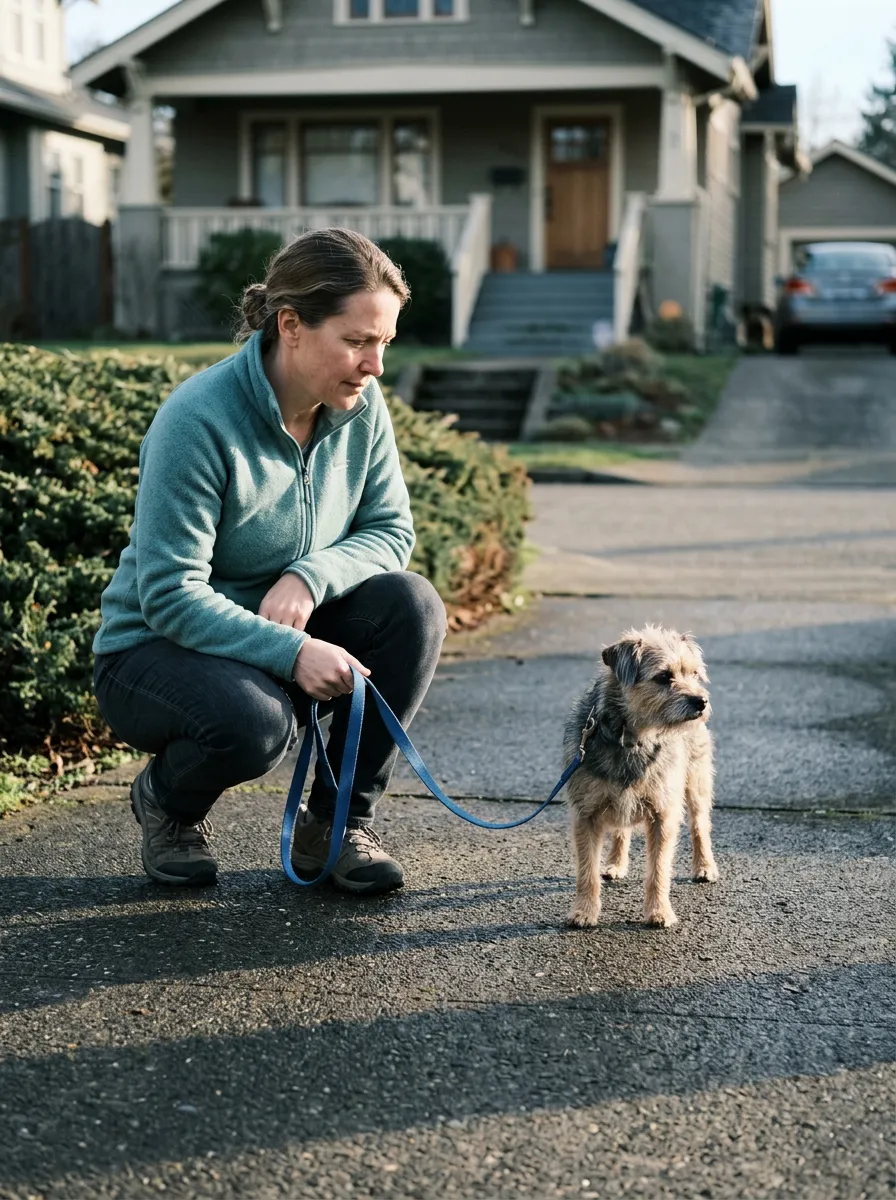
Your dog isn't being stubborn. She's telling you which direction to go
Your dog isn't being stubborn. She's telling you which direction to go.
When a dog plants her feet on the sidewalk and refuses to turn around, everyone reaches for the same word: stubborn. But watch what she'll actually accept. Cross the street and she walks. Loop around the block and she walks. She's not refusing to move. She's refusing to retrace her steps — and that's a very specific message.
I had a session recently with a woman whose rescue dog does exactly this. Nine-ish, a strange and wonderful mix, four months frozen in a foster laundry room before she came home. It took two months just to get a leash on her. Now walking is the entire point of her day, and she's got opinions about how it goes.
Her person described it perfectly: she puts her brakes on. If they've walked up one side of the sidewalk, she will not come back down that same side. Forgot the poop bags and need to pop back to the house? She'll stand on the porch, leash dropped, waiting patiently — but she will not walk those ten feet back toward the door. Cross the street though, and off she goes. Circle around, and she's fine. Come at it from a different angle and there's no fight at all.
That's not stubbornness. That's a rule. And rules that specific are worth reading.
Animals mirror us literally, not poetically
When I look at an animal, I'm looking at what's mirroring in the human. Not in a soft, symbolic, isn't-that-lovely way. In a very literal way, right down to the phrasing.
So I asked her: digging your heels in. What does that remind you of?
She laughed, because the family joke is that they're all breaking bones in their feet. Then it came out. Twenty-four years at the same university. A department chair job she's been quietly asking herself about since 2009. Her words: she's never actually dug her heels in there. She's stayed in a liminal space for a long, long time. She keeps too busy to figure out the next step. And she ruminates over every decision she makes — constantly going back over ground she's already covered.
Sixteen years of not moving forward, not turning back, circling the same block in her head.
And there's her dog on the sidewalk, planted, saying: I'm not walking that route again. Give me a different way and I'll go.
Ask what she's making you do
Here's the question that changes the whole thing. When your dog stops dead, don't ask how to make her move. Ask what she's making you do.
In that moment, this dog does two things to her person. First, she forces her to be present. You can't sort out a stuck dog while you're mentally three tasks ahead — you have to actually be there, on that patch of sidewalk, with that dog. Second, she forces a change of route. Cross the street. Zigzag. Try the other way first.
Present, and doing it differently. For a woman who fills every hour so she doesn't have to face a decision, that's not an inconvenience on a walk. That's the exact prescription, delivered twice a day by a thirty-pound Pekingese mix.
The same thing showed up somewhere else in her life, and she'd never clocked it. Her dog can't fly — too big for under the seat, and she won't put her in the hold. So for five years, every time she went to help her dad, she drove. Three days out, three days back, twelve or so trips. Everyone in her life asked why she'd do that for a dog.
Think about what those three days actually were. She wasn't at anyone's bedside. She wasn't managing anyone's medication. She wasn't the person everybody calls. She was driving. For three straight days she physically could not take care of anybody — and after sixteen years of constant emergency-mode caretaking, that dog was the only thing on earth that could book her that time off.
She didn't do it for herself. She'd never have done it for herself. She did it for the dog.
The bit people miss about reactivity
There's a second layer here, and it's the one that usually gets skipped. This same dog reacts hard to the dogs next door. Her person is aware she's got a part in it. Her elderly aunt, who's staying with her and is running on a badly frayed edge, is tense from the moment the leash goes on — and the dog is noticeably worse with the aunt than with anyone else.
Three of them, all feeding off each other. The aunt winds up, she winds up, the dog winds up, and everybody's braced before they've reached the corner.
Here's what's actually happening on that walk: you spot the dog up the block before your dog does. You start bracing. You're already planning the cross. Your dog isn't reacting to that dog — she's reacting to you reacting to that dog. There's an automatic response running in her, and what keeps it alive is the automatic response running in you.
This is why training and animal communication both come with the same quiet caveat — it should get better. They're working on her. Only her. Nobody's touched the other half of the loop.
And to be clear, none of that work was wasted. When the reactivity in the human settles, all that training you did doesn't get thrown out. It starts working. It was fine all along. It just couldn't land in a house where everyone was braced.
Read the rule, not the resistance
So the next time your dog does the thing everyone calls stubborn, get specific about it. Not "she won't walk." What exactly will she not do, and what will she happily accept instead?
Won't retrace her steps, but will cross the street. Won't be picked up, but will wait. Won't go back, but will go around.
That level of detail is never random. And when you hold it up against your own life, it's usually so on the nose it's almost funny.
She's not being difficult. She's standing on the sidewalk telling you the same thing you've been telling yourself for years: not that way again. Come at it differently.


