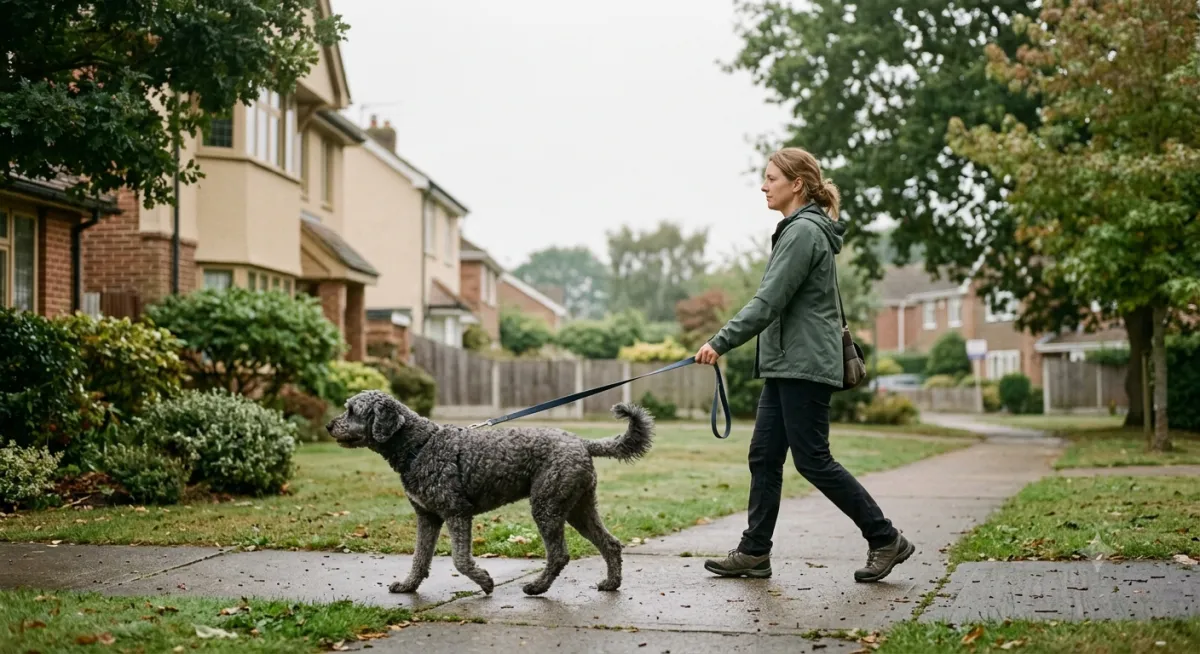
Why Your Reactive Dog Won't Settle Unless You're Managing Him.
Your Dog Can't Settle Because You Can't Decide
If your reactive dog only holds it together when you're actively managing him, stop looking at his focus. Start looking at what happens in you when there's nobody around to tell you you're doing it right.
I sat down with a woman last week. Poodle cross, five years old, reactive to people, dogs, kids and skateboards. I asked her to give me the issue in five words or less.
She said, "a lack of focus on me."
He's constantly scanning. If she prompts him to check in, he walks beautifully. If she doesn't, they're in trouble.
So I asked her something that had nothing to do with her dog. Are you an overthinker? Are you a scanner? Are you somebody who's always checking?
Not for danger, she said. But yes. Am I doing this well? Are people happy with what I'm doing?
About thirty seconds later she used the words imposter syndrome.
And there it was.

The mirror nobody points out to you
Her dog does better when he's locked onto one person. She does better when she's got one person telling her she's on the right track.
Her dog falls apart when three people are giving him three different signals. She falls apart when three professionals are giving her three different opinions.
Sound familiar yet?
He's not reflecting some vague energy back at her. He's reflecting the exact shape of it. The scanning. The needing one clear voice. The not quite settling until somebody confirms it's fine.
That's what animals do. They pick up whatever you're running and they run it back at you in a form you can actually see. Because you can't see it in yourself. Nobody can.
The bit that surprised her
He doesn't need to focus on her. He just needs to focus on someone.
She told me this herself and didn't notice she'd said it. At daycare, once she hands the leash over and the other person releases him from the sit, he's fine. He knows who he's looking to. At the vet he's fine too, as long as the exam stays all business and nobody tries to make friends with him halfway through.
So it was never about her.
It was about clarity. One clear voice, one clear boundary, and he settles.
Which is exactly what she wants for herself. And exactly what she isn't getting.
The part the training world can't reach
She's got a behaviour vet who's positive only. A daycare that does balanced training. A trainer who tells her she micromanages. Positive only trainers who say the head halter is aversive, and a balanced trainer who says the head halter is worse than a prong.
She's tried the tools. She's watched her own dog's response to every one of them. She's made her calls.
And then she has to defend those calls. Over and over and over.
Her word for it was exhausting.
Not because she doesn't know her dog. She lives with him. She's known him longest. She's the actual expert in the room.
But every time an authority figure says something different, the whole decision cracks back open.
Okay, so here's what I want to say clearly, and I'm not taking a shot at anybody. Your trainer isn't trained to help you. She's trained to tell you to stop doing that. There's nothing in her certification about your emotions, or how you move through the world, or the limiting beliefs you've been hauling around for thirty years. Different lane entirely.
So when she says "don't tense up on the leash" and you're thinking yeah, sure, good luck with that... you're right.
Not because you're not trying. Because it isn't a choice.
Why "just relax" was never going to work
Your conscious mind runs one question in the background, over and over. Have I seen this before? Was it a problem?
Yes? Then we do the thing we always do.
Skateboard appears. Body braces. Breath goes shallow. Hand tightens. It's already done by the time you clock it.
You can't willpower your way out of an automatic. All you can do is change the answer underneath it, so the next time something comes, the thing that fires is we're calm instead of this is bad.
And here's the good bit. When you stop bracing, it doesn't mean your dog suddenly loves the skateboard. It means he's got nothing to feed off. Over time he starts mirroring the calm instead, because that's what's on offer now.
There are as many ways to train a dog as there are dogs
Then factor in the people.
I told her to think about food. Nobody's eating carbs. Now everybody's eating carbs, but only the right carbs. Somebody just tell me what to eat.
Except nobody can, because every single body is different. There's no one way to eat. There aren't five ways to eat. There are as many ways as there are people on the planet, and sometimes it takes you fifty years to work out which one is yours.
It sucks. But that's how it goes.
Dog training is the same thing, except now you've got two nervous systems in the mix instead of one.
So when somebody tells you their approach is the only thing that works? It isn't. A year from now there'll be a shiny new thing in the dog world. There always is.
The real problem isn't the tool. It's the gripping.
What I saw in her wasn't indecision. It was the opposite.
She was trying to lock in the one correct method and never have to revisit it, because revisiting it means opening herself back up to being judged.
But this was never going to be one decision and done.
As he ages, as she ages, as he racks up new experiences, it shifts. Something could happen tomorrow that means she needs to do more for a while. Something could happen tomorrow that means she can do less.
Staying flexible isn't flakiness. It's the job.
What I actually told her
Make the call, then stop relitigating it. You're allowed to say this is my dog and this is how we're doing things, and then just leave it there.
Set the boundary with the professionals, not only with the dog. And notice something while you're at it. The boundaries you find hardest to set with people are the exact ones your dog is asking you for.
Stop treating "I've done a lot of different things" as evidence against yourself. Every single thing you've ever studied traces straight into how you work now. You weren't wandering. You were gathering tools.
Try the new thing. She was worried that changing her approach would wreck what she's built with him. It won't. Doing what feels right to you strengthens the relationship. Doing what somebody told you to do while your gut is saying no? That's what changes it.
And the big one. The judgment of yourself ends today. Not next month once you've finally got it figured out. Today. Then again tomorrow when it creeps back in, because it will.
If you're squirming a bit reading this
Have a look at what your animal does when he's at his most difficult. Not the trigger. The shape of it.
The scanning. The bracing. The needing permission. The way he won't settle until somebody tells him it's okay.
Then ask yourself, honestly, where you do the same thing.
That's usually where the work actually is. And it's the bit no collar, no leash and no training protocol is ever going to touch, because it isn't happening at the end of the leash.
It's happening at your end.
When you're ready to look at that side of it, that's what I do.
If this landed, When Stress Hits Home goes deeper — how chronic stress moves through your animal, and what they're reflecting back. Click here to read more


