Why your dog barks at some people and not others
Animals can handle your anger. What they can't handle is you pretending you're fine.
Your dog isn't reacting to the man in the helmet. She's reacting to the face you're making at the man in the helmet, and the fact that your face and your insides are telling two completely different stories.
I was on a call recently with a woman who has three dogs. Right at the start, describing the youngest one, she said something that gave me the entire situation before we'd properly begun.
"She's perfect on the outside, but she's very stressed on the inside."
I let her keep talking for a bit. Then I asked her the only question worth asking.
How much of that sentence describes you?
The duck on the pond
She pushed back at first, the way most people do. "Well, I'm not perfect on the outside either."
Sure. But are you trying to be?
That landed. Because perfect isn't really the word. The word is the gap. One thing is happening out here where everyone can see it, and something else entirely is happening underneath. The duck on the pond. Gliding along, looking lovely, legs going like mad below the waterline.
Most of us have been doing that so long we don't clock it as anything. It's just Tuesday.
Your animal clocks it every single time.
It was never about the helmet
She gave me a perfect example without meaning to.
Last summer a friend of her husband's turned up unannounced. On a motorbike. Full leathers, helmet, the works. Her dog completely lost it, and she was furious. Not at the dog. At the man who'd arrived at her house without a word of warning.
So she did what most of us do. She smiled and said hello and hid it.
Here's what almost everyone concludes from a moment like that. It's because he was a man. It's because of the helmet. It's the dark clothes, the bike, the noise.
It's none of those things.
Imagine the same man, same bike, same helmet, but he's someone you adore and haven't seen in years. There's still barking, because a stranger has appeared out of nowhere. But it's a completely different bark and it's over in about eight seconds, because what your dog is reading off you is delight.
This is where the stories get built. Your dog barks at someone in a hat once. You decide hats are the issue. Now every time a hat comes up the path, you're the one who tenses first, and your dog reads the tension and does exactly what she's been doing all along, which is respond to you.
For this woman it's umbrellas. She sees one coming and she's already braced.
What they actually can't stand
Here's the piece nobody tells you.
Animals aren't repelled by your anger. Anger is clean. Anger is information. They can work with anger.
What repels them is incongruency. The outside saying one thing while the inside says another.
Because in that moment you become unpredictable, and unpredictable is genuinely frightening if you're small and you live with someone and you depend on them. She doesn't know what she's getting from you. She can feel the anger sitting in the room, she can see your lovely social face, and the two don't reconcile. So some part of her stays up, waiting to find out which one is real, and quietly wondering whether it's going to turn on her.
That's a dog on duty. That's a dog who steps in.
Say the thing out loud
The fix is almost insultingly simple, and it's free.
Tell her.
Once the man was outside and the boundary was set, this woman could have turned around and said: that startled me. I'm angry right now. It's not about you. It's because I don't like people turning up at my house without telling me first.
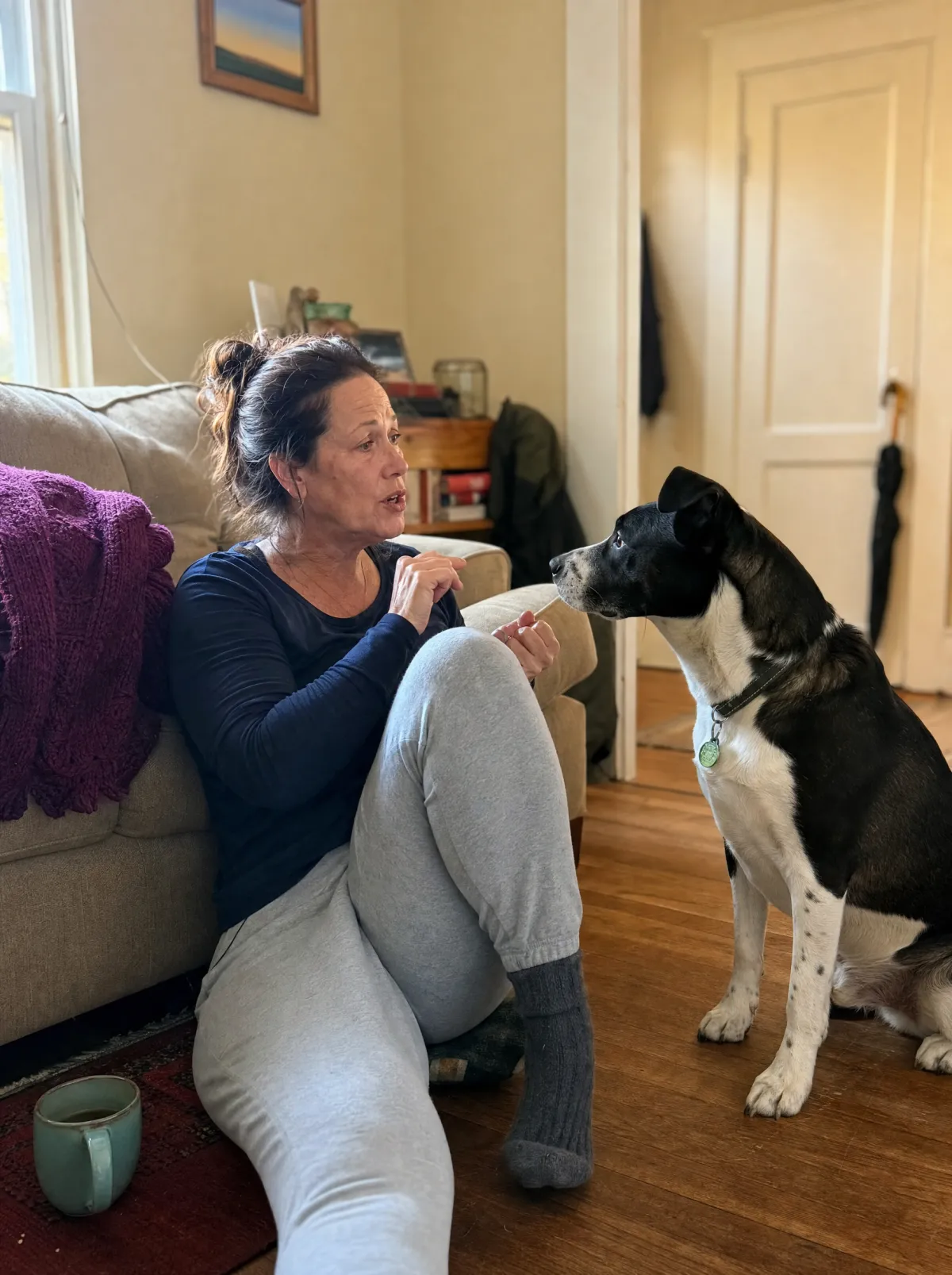
Say it out loud, in actual sentences, like she understands you. Because she does.
That's the other thing I asked her to change. Assume competence. Not baby talk, not that voice we all do. Talk to her like she's fifteen and she's asked you a fair question, which is: why are you like this right now?
And when she tells you something, thank her. My dog lets me know when the delivery driver arrives. I don't need a doorbell for that. I thank him and we go and get the parcel and he stops. If you ignore someone who's giving you information, they don't stop. They get louder. You'd do the same.
The rules you don't believe in
Then we found the other gap, and this one was bigger.
She's a rule follower. Gets genuinely irritated by drivers who don't follow the rules. And her youngest dog? The boss of the household. The one who tells the other two off when they step out of line. The one whose whole problem is other dogs approaching head on, which, if you know dogs at all, is not how it's done. Bums first. Those are the rules.
They pick up your rule and then they enforce it for you. My own dog doesn't care about bicycles on the road. On the sidewalk, he loses his mind. Guess who taught him that.
But here's where it got interesting. She admitted, and said she'd never told anyone this, that she finds all the recommended enrichment activities boring. She'd been told her herding breed needs this and that. So she does it. And she hates it. What she actually wants is to walk in the woods and let the dog run.
That's incongruency too. Doing something you don't believe in because someone told you it was the rule, while every part of you is somewhere else. Your dog is standing in the middle of that tug of war.
So confess it to her. I'm as bored as you are. Here's why we're doing it anyway. Here's what I'm actually worried about.
You're allowed to be angry. You're just not allowed to keep it.
One more thing, because it's the piece that changes walks.
Anger means a boundary was crossed. That friend turned up unannounced and yes, that's a real boundary and you're entitled to be cross about it. That's not the problem.
The problem is how long you carry it.
I used to spend the entire rest of the walk spinning after my dog reacted. Angry at him, at myself, at the person who should have crossed the road. Then the next dog appears and of course he goes up, because I never came down from the first one. Then I'd get home and tell my husband the whole saga. I never let the walk go.
Now he barks once and we keep moving. And then it's finished. Up, and back down. That's the whole design.
So when it happens: one bark, keep moving, don't stop, don't stare, don't square up, don't get into it with the other person. Once you're clear, let her sniff everything she wants, because that's her draining the charge off. And while she does that, you breathe. That bicycle came out of nowhere, nothing bad happened, we barked, we moved on. Good job.
Both of you get to come down.
When you're ready
If you're reading this and recognizing yourself in the bracing and the spinning and the pleasant face over the top of it, the Reactive Dog Reset is where I'd start. It's the work I made for myself first, because I've got a reactive dog and I worked out fairly quickly that I was every bit as reactive as he was.
It won't make your dog fine with confrontation. Nothing will, and honestly it's an unreasonable thing to ask of her. What it does is train the going up and the coming back down, in you, so there's less for her to feed off next time.
And if you've already been through it and you've drifted away from listening, go back. The woman on that call had done all three weeks and stopped, and she'd noticed herself getting tentative on walks again without connecting the two. Keep listening. It isn't a crutch. It's just repetition telling your system, over and over, that it's safe to come down.


